
FSMO Roles Part-1
Introduction
In Active Directory (AD), FSMO roles (Flexible Single Master Operations) are critical for maintaining stability and consistency across domains and forests. These roles, often called Operations Master Roles, ensure that essential functions like schema changes, domain naming, RID allocation, time synchronization, and infrastructure updates happen smoothly.
Understanding FSMO roles is vital for IT professionals managing AD environments, and it is also a frequent interview topic. In this post, we’ll cover:
- What FSMO roles are.
- Different types of FSMO roles.
- How they work in Primary Domain Controller (PDC), Additional Domain Controller (ADC), and Domain Controller (DC).
- Why FSMO roles matter in real-world scenarios.
What Are FSMO Roles?
FSMO stands for Flexible Single Master Operations. These roles define which server in an Active Directory environment has the authority to perform specific critical operations.
Some professionals also refer to FSMO as:
- Operation Master Roles
- Disaster Recovery Roles
👉 Regardless of the name, FSMO roles are essential for keeping your Active Directory consistent and error-free.

Types of FSMO Roles
There are five FSMO roles in total:
1. Schema Master (Forest-wide)
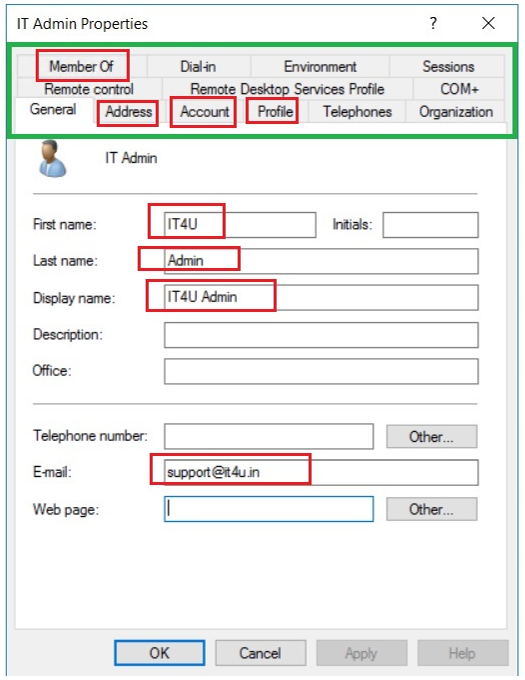
- Controls all schema updates in Active Directory.
- Defines object attributes like User ID, phone number, or email.
- Only one Schema Master exists per forest.
2. Domain Naming Master (Forest-wide)
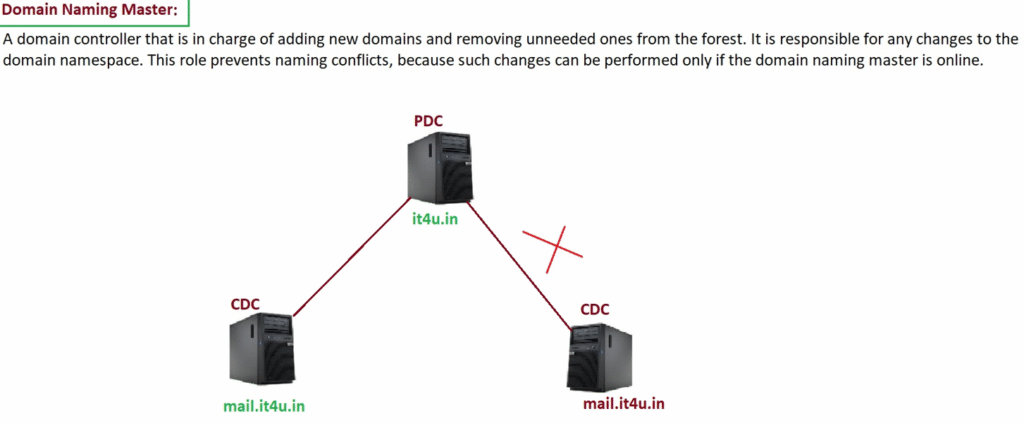
- Manages domain additions or removals in a forest.
- Prevents duplicate domain names.
- Without it, you cannot create or remove domains.
3. RID Master (Domain-wide)
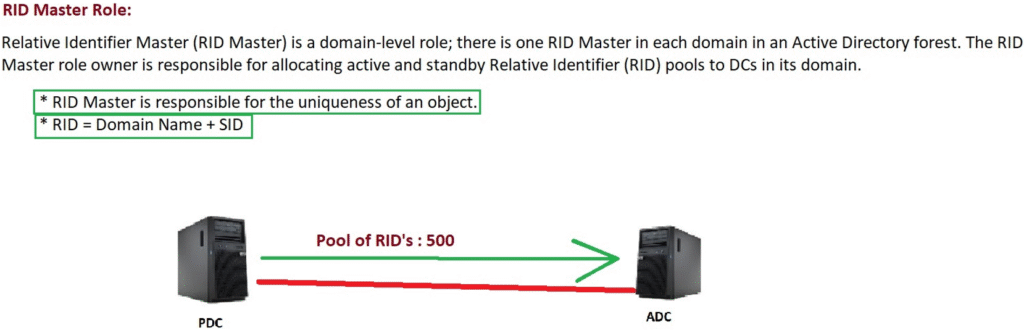
- Responsible for issuing Relative Identifiers (RID).
- Ensures each object (users, computers) has a unique Security Identifier (SID).
- Without RID Master, no new objects can be joined to the domain once the RID pool is exhausted.
4. PDC Emulator (Domain-wide)
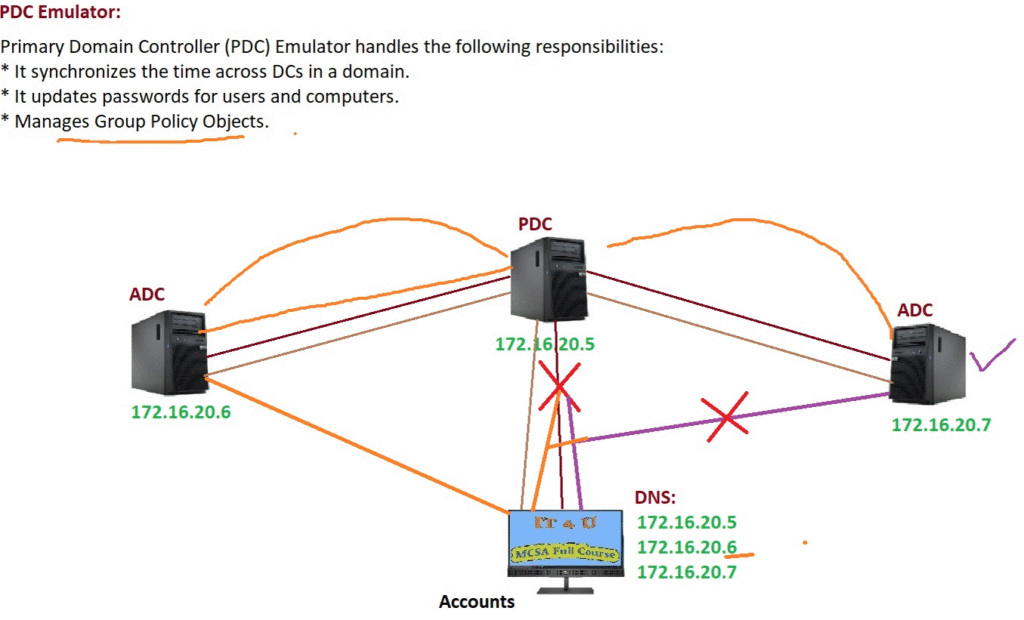
- Synchronizes time across domain controllers.
- Manages Group Policy Objects (GPOs).
- Handles password changes and authentication.
- Ensures backward compatibility with older systems.
5. Infrastructure Master (Domain-wide)
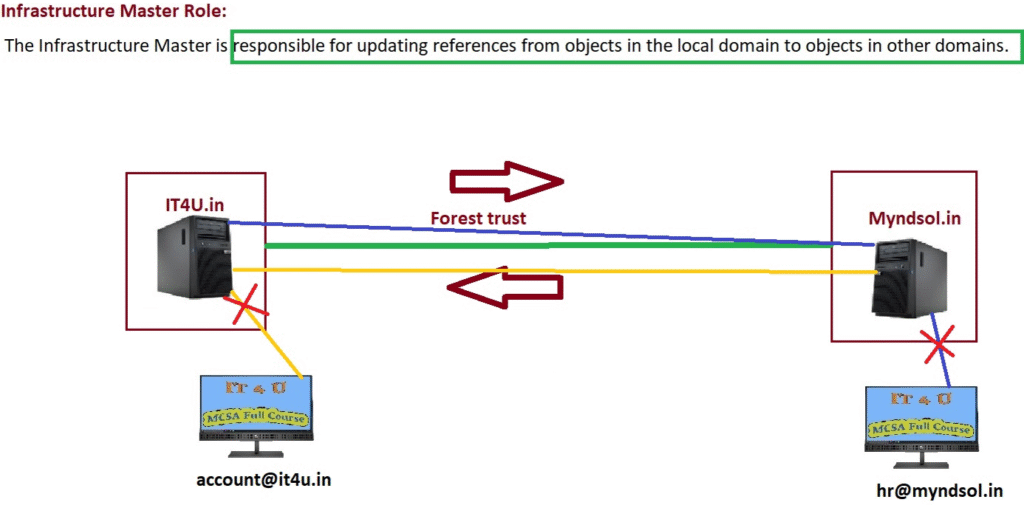
- Maintains references between objects in multiple domains.
- Ensures user and group information is updated across domains.
- Crucial when trust relationships exist between forests or domains.
FSMO Role Distribution Example
When you create a new forest and domain:
- The Primary Domain Controller (PDC) automatically holds all five FSMO roles.
- An Additional Domain Controller (ADC) is just a replica — it has zero FSMO roles.
- A Child Domain Controller (DC) usually holds three FSMO roles (RID, PDC Emulator, and Infrastructure Master).
👉 This is a common interview question:
- PDC = 5 FSMO roles
- ADC = 0 FSMO roles
- Child DC = 3 FSMO roles
Why FSMO Roles Are Important

Imagine if your PDC goes down permanently:
- ADCs continue authentication temporarily (replicas).
- But critical functions like schema updates, domain naming, RID distribution, or password syncs may fail.
- That’s why transferring FSMO roles is essential when promoting an ADC to act as a new PDC.
Without correct FSMO role management, you may face:
- Login failures.
- Group Policy misbehavior.
- Domain trust issues.
- Infrastructure mismatches across domains.
Conclusion
FSMO roles are the backbone of Active Directory operations. Knowing their purpose and distribution helps you troubleshoot AD issues and prepare for real-world scenarios like disaster recovery.
In this part (Day-34, Part-1), we covered what FSMO roles are, their types, and why they matter.
👉 In the next part, we’ll explore how to transfer FSMO roles — both normally and forcefully — using GUI and PowerShell.
💡 What do you think about FSMO roles? Have you ever faced FSMO-related issues in your environment? Share your experience in the comments!
❓ Frequently Asked Questions (FAQ)
1. What are FSMO roles in Active Directory?
FSMO (Flexible Single Master Operations) roles are special domain controller tasks that ensure consistency and stability in Active Directory environments.
2. How many FSMO roles are there?
There are five FSMO roles: Schema Master, Domain Naming Master, RID Master, PDC Emulator, and Infrastructure Master.
3. Which FSMO roles are forest-wide?
The Schema Master and Domain Naming Master roles are forest-wide.
4. Which FSMO roles are domain-wide?
The RID Master, PDC Emulator, and Infrastructure Master roles are domain-wide.
5. How are FSMO roles distributed?
- A new PDC holds all 5 FSMO roles.
- An ADC holds none (0 roles).
- A Child DC typically holds 3 roles (RID, PDC Emulator, Infrastructure Master).
6. Why are FSMO roles important?
They prevent issues with schema updates, domain naming, authentication, password changes, and inter-domain communication. Without them, AD can fail.
7. What happens if the FSMO role holder server is down?
If the server holding FSMO roles fails, you must transfer or seize the roles to another domain controller to maintain AD functionality.
FSMO Roles, FSMO Roles in Active Directory, FSMO Roles Explained, Active Directory FSMO, Schema Master, Domain Naming Master, RID Master, PDC Emulator, Infrastructure Master, Active Directory Interview Questions, MCSA Full Course Hindi, IT4U Training





Add comment